Table of Contents
Plastic injection moulding — whether you spell it the British way or the American way (injection molding) — is one of the most widely used manufacturing processes in the world. It powers everything from automotive dashboards to household appliances. But when the end application is a medical device, the rules of the game change entirely.
In industrial or consumer manufacturing, the primary concerns are cost, speed, and aesthetics. In the medical sector, those concerns are still relevant — but they sit beneath a far more demanding foundation: patient safety, sterility, regulatory compliance, and traceability.
A failed plastic housing on a consumer product is an inconvenience. A failed component inside a diagnostic device, surgical instrument, or drug delivery system can cost a patient their life. This is why medical injection moulding demands a completely different level of engineering discipline, quality management, and manufacturing control.
"The difference between standard injection moulding and medical-grade injection moulding isn't just about materials or machines — it's about the entire quality system that surrounds every single step of the process."
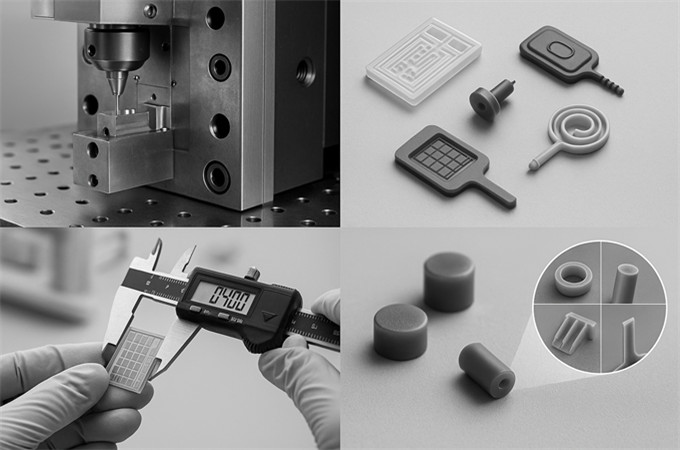
Injection moulding is used across virtually every category of medical product. The versatility of the process — capable of producing everything from microscale components to large device housings — makes it the dominant manufacturing method in the healthcare sector.
Syringe barrels, plungers, auto-injector housings, IV components, and inhaler parts requiring tight dimensional tolerances.
Microfluidic chips, test cassette housings, pipette tips, centrifuge tubes, and specimen containers for in vitro diagnostics.
Scalpel handles, retractor grips, single-use procedural tools, and sterile packaging components designed for one-time use.
Outer shells for patient monitors, portable diagnostic devices, wearable health trackers, and imaging equipment.
Luer-lock fittings, stopcocks, tubing connectors, and catheter components that demand leak-free, high-precision geometry.
Instrument handles, tray systems, and structural supports where strength, sterilizability, and biocompatibility are all required.
These diverse applications share a common thread: each component interacts — directly or indirectly — with patients or with the fluids, drugs, and biological specimens that affect patient outcomes. That shared context drives the entire framework of requirements discussed in the next section.
This is the section that separates a qualified medical injection moulding partner from a general-purpose moulding shop. Compliance is not a checkbox — it is a living system of documentation, process control, and continuous improvement.
ISO 13485 is the international standard for quality management systems specifically applied to the medical device industry. It goes beyond ISO 9001 by requiring demonstrable control over design, production, installation, and servicing. A certified moulding manufacturer must maintain documented procedures, validated processes, complete traceability for every lot, and a robust corrective and preventive action (CAPA) program. Mold validations per ISO 13485 — including IQ, OQ, and PQ protocols — are essential to ensure process consistency before mass production begins.
For devices entering the U.S. market, compliance with FDA's Quality System Regulation (21 CFR Part 820) is mandatory. This regulation governs design controls, purchasing controls, production and process controls, nonconforming product handling, and records management. A contract moulding partner working on FDA-regulated devices must operate with these requirements embedded into their quality system — not treated as something separate.
Particulate contamination is a critical risk for medical components. ISO Class 8 cleanrooms (equivalent to Federal Standard 100,000) control airborne particulate counts, temperature, humidity, and personnel gowning protocols to protect product integrity. Components such as syringe plungers, diagnostic consumables, or any part that contacts a patient's body or specimen must be moulded and handled in a controlled environment to meet cleanliness and sterility expectations.
ISO 10993 defines a series of tests to evaluate the biocompatibility of materials used in medical devices — addressing cytotoxicity, sensitization, irritation, systemic toxicity, and genotoxicity, among others. The specific tests required depend on the nature and duration of patient contact. Your moulding partner should understand which material grades and processing conditions meet these requirements and be able to provide supporting documentation.
Material selection is one of the most critical decisions in medical device design. Not all plastics are created equal — and in a medical context, the difference between a general-grade resin and a medical-grade equivalent can determine whether a component passes regulatory review or fails biocompatibility testing.
⚠ Important Note
Always specify medical-grade resins from approved suppliers. Standard industrial grades of the same polymer may contain additives, lubricants, or colorants that are not cleared for patient contact. Your contract moulding partner should be able to provide full material traceability documentation including lot numbers and certificates of conformance.
For medical applications, the injection moulding process follows a structured development and validation pathway before any production parts are released. This pathway is not optional — it is the backbone of regulatory compliance and long-term quality assurance.
Engineering teams review the part design for wall thickness consistency, draft angles, gate locations, and ejection feasibility. DFM review at this stage prevents costly redesigns after tooling is cut and is especially important for the tight tolerances required in medical components.
Rapid prototypes — using 3D printing or soft tooling — are produced for early functional and dimensional validation. Prototyping with production-grade materials catches design issues before committing to final hard tooling, significantly reducing time-to-market.
The production mold is fabricated — typically from hardened steel for high-volume medical parts. In-house tooling capability is a major advantage, as it enables faster iteration and tighter communication between mold design and production engineering teams.
Installation Qualification (IQ) confirms the equipment is installed correctly. Operational Qualification (OQ) verifies the process operates within defined parameters. Performance Qualification (PQ) demonstrates that the process consistently produces conforming parts under actual production conditions. These three phases, documented per ISO 13485, are mandatory before any medical component can enter production.
During full-scale production, Statistical Process Control (SPC), first article inspection, and ongoing dimensional measurement ensure every batch meets specification. In cleanroom environments, additional environmental monitoring and personnel controls are maintained throughout the production run.
Every production lot must carry complete traceability: resin lot numbers, machine parameters, in-process inspection records, and final release documentation. This Device History Record (DHR) is the audit trail that regulators, customers, and internal quality teams rely on throughout the product lifecycle.
Choosing a contract manufacturer for medical injection moulding is a high-stakes supplier qualification decision. Price is rarely the right primary filter. Here are the criteria that matter most:
This is the baseline requirement. A certified supplier has undergone third-party audits and demonstrated systematic quality management. Ask for their certificate and verify the scope — it should explicitly cover injection moulding of medical device components.
Verify that the manufacturer has a certified cleanroom (ISO Class 7 or Class 8 minimum for most applications) and that it is integrated into the production workflow — not simply a storage area used after moulding in an uncontrolled environment.
Manufacturers with in-house mold design and fabrication capabilities can turn around custom tooling faster, make modifications more efficiently, and maintain tighter control over mold quality. This is especially valuable during the validation phases, when iteration speed directly impacts development timelines.
Insist on a supplier that not only performs mold validations but also partners with your team throughout the process — generating and reviewing the documentation needed to support your design history file and regulatory submissions.
Your supplier should be capable of supporting you from prototype through mass production without you needing to transfer to a different manufacturer at scale. Look for a broad range of press tonnage (e.g., 6–610 tons), 24/7 production capability, and a transparent capacity planning process.
Years of experience in medical injection moulding matter. A supplier with decades of work with medical device OEMs, pharmaceutical companies, and diagnostics manufacturers brings institutional knowledge that reduces risk at every stage of your project — from material selection to regulatory audit readiness.
Medical injection moulding — whether you call it injection moulding or injection molding — is one of the most technically demanding and consequential manufacturing disciplines in the plastics industry. Done right, it enables the precise, consistent, contamination-free production of components that protect and extend human lives. Done poorly, it introduces risks that no company in the healthcare supply chain can afford.
The key to success is choosing a manufacturing partner who treats compliance not as an administrative burden, but as a core competency — one who brings expertise in ISO 13485, cleanroom operations, mold validation, and material science to every project, from the first prototype to the millionth production part.
Ready to Start Your Project?
With over 35 years of experience, ISO 13485 certification, ISO Class 8 cleanrooms, and in-house tooling, Trademark Plastics Inc. is built to support medical device companies from prototype to full-scale production.