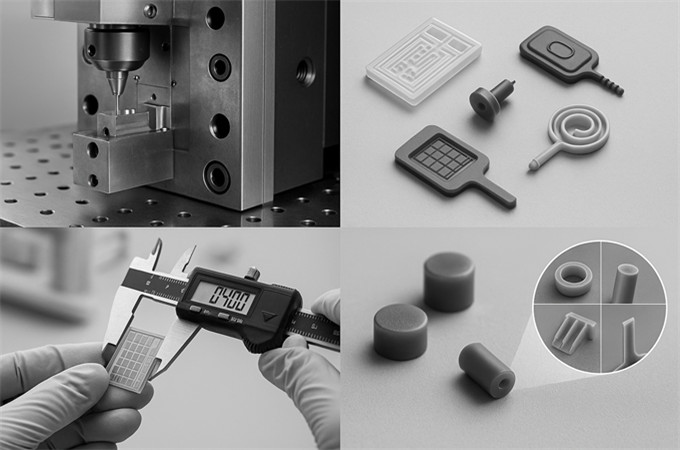

For global medical device OEMs, R&D engineers, and procurement managers, the rapid evolution of minimally invasive therapies, point-of-care diagnostics (IVD), and bio-implantable technologies has driven a massive wave of device miniaturization. Squeezing complex mechanical, fluidic, or electrical functionalities into components smaller than a grain of rice is no longer a futuristic concept—it is a standard market expectation in 2026.
However, transitioning from traditional plastic injection molding to medical micro molding is not a simple matter of scaling down. It introduces extreme challenges in fluid dynamics, tooling design, polymer shear behavior, and regulatory compliance.
This comprehensive guide serves as an authoritative technical and procurement blueprint. It details how to master micro-scale tolerances, select biocompatible resins, apply Design for Manufacturability (DFM) rules, and secure robust validation (IQ/OQ/PQ) under ISO 13485 and FDA frameworks to de-risk your next high-precision product launch.
In the micro-medical domain, part weights are often measured in milligrams, and critical dimensions are defined in microns rather than thousandths of an inch. Managing these extreme scales requires specialized machinery and steel tooling designed specifically to withstand the unique physics of micro-injection.
While standard medical molding operates comfortably within tolerances of ±0.05mm(±0.002in), medical micro molding regularly demands tolerances as tight as ±3 to ±5micron(±0.0001 to ±0.0002 in). Achieving this ultra-high precision is critical for applications like:
Microfluidic Cartridges & IVD Chips: Where channel depths must remain perfectly consistent to ensure accurate capillary fluid flow and prevent test result variations.
Ophthalmic & Micro-Surgical Tools: Where tiny micro-features dictate the mechanical cutting, gripping, or fluid-delivery performance of the device.
Implantable Components: Where even a minor dimensional deviation can cause mechanical failure or tissue irritation inside the human body.
You cannot run micro-molded parts on standard injection molding machines. Doing so leads to excessive resin residence time in the barrel, causing thermal degradation of expensive medical-grade polymers. Success requires:
Dedicated Micro-Injection Presses: Utilizing ultra-small injection screws (often 12mm to 14mm or smaller) and micro-plungers designed to meter and inject shot sizes weighing a fraction of a gram with extreme volumetric repeatability.
Sub-Micron Steel Tooling: Molds must be machined using high-speed micro-milling, femtosecond laser ablation, and high-precision Wire-EDM. Cavity inserts must integrate high-sensitivity cavity pressure and temperature sensors to monitor and control the molding process in real-time, block-by-block.
High-performance medical polymers behave differently when forced through microscopic gates and ultra-thin wall sections. The intense shear rates experienced during injection can permanently alter the polymer's molecular structure if the material is not matched perfectly to the application.
When molten plastic is injected into extremely thin micro-features, it experiences immense shear stress. This stress drastically lowers the material’s viscosity (shear thinning), which is helpful for filling thin walls, but it can also cause molecular degradation and weaken the mechanical properties of the finished component if not carefully managed.
Selecting a resin with the ideal Melt Flow Rate (MFR) and thermal stability is critical to ensuring the part retains its structural integrity post-molding.
Choosing the right medical-grade material depends on the mechanical, optical, and biocompatibility requirements of the device:
| Polymer Grade | Key Technical Advantage | Ideal Micro-Medical Application |
| PEEK (Polyetheretherketone) | Bioinert, highly stable, exceptional mechanical strength, autoclave sterilizable. | Implantable orthopedic devices, dental implants, micro-anchors. |
| COP (Cyclo-Olefin Polymer) | Ultra-high optical clarity, low autofluorescence, excellent moisture barrier. | Microfluidic cartridges, IVD wells, optical lenses. |
| LCP (Liquid Crystal Polymer) | Exceptional flowability, high temperature resistance, zero shrinkage. | High-density micro-connectors, ultra-thin walled surgical housings. |
The most common reason medical micro-molding projects fail or suffer from long delays is a lack of early-stage Design for Manufacturability (DFM). Applying micro-specific design rules early protects your project from costly re-tooling down the line.
Maintain Wall Thickness Consistency: While micro-molding enables walls as thin as 0.1mm (0.004in), rapid transitions between thick and thin sections cause uneven cooling, molded-in stress, and severe part warpage. Keep wall transitions as uniform as possible.
Optimize Micro-Gate Placement: Gate location dictates fiber orientation, weld line positions, and venting efficiency. In microfluidics, the gate must be positioned to prevent "jetting" (where resin sprays into the cavity rather than filling it uniformly) and to avoid placing a vestige in a functional area.
Design Generous Draft Angles: Ejecting a microscopic part with fragile, sub-millimeter features requires sufficient draft angles. Even a fraction of a degree (typically 0.5° to 1°) can make the difference between a clean ejection and a torn, ruined part.
At Trademark Plastics, Inc. (TPI), we believe in solving manufacturing challenges before the steel is cut.
Our engineering teams utilize advanced scientific molding principles combined with state-of-the-art Moldflow 3D simulation software. By analyzing gate locations, shear rates, and venting pathways during the initial design phase, TPI helps OEMs optimize part geometries. This collaborative engineering approach regularly compresses product development lifecycles by up to 30%, saving clients from expensive tooling modifications and delayed clinical trials.
Achieving micro-scale tolerances is only half the battle; the other half is proving those dimensions consistently. In medical micro molding, traditional physical measurement tools like micrometers or contact-based coordinate measuring machines (CMMs) are rendered obsolete.
At the micron level, physical probe tips are often larger than the micro-features they are trying to measure. Touching a delicate microfluidic channel or a sub-millimeter surgical tip can physically deflect or damage the polymer part, leading to false rejects or, worse, undetected dimensional failures.
Multi-Sensor Optical Measuring: We deploy advanced OGP (Optical Gaging Products) smart scope systems that measure sub-micron features using advanced video, laser, and multisensor technologies.
Non-Contact Profilometry: This allows us to inspect critical microfluidic groove depths and wall heights without ever touching the molded part, ensuring 100% dimensional compliance while maintaining physical and structural integrity.
As medical devices shrink, the need to consolidate multiple functions into a single micro-component becomes paramount. This has driven the industry toward micro two-shot (2K) and insert micro molding.
Integrating a rigid thermoplastic (like PEEK) with a soft elastomeric seal (such as TPU or TPE) in a component smaller than a grain of rice requires extreme tool design precision. Sourcing teams must ensure the mold features perfectly synchronized runner gates and hot runner systems to prevent the second-shot resin from crushing or washing away the delicate first-shot micro-insert.
This is where Trademark Plastics, Inc. (TPI) provides a distinct competitive advantage.
Our engineering team specializes in the co-molding of complex, multi-material micro devices. By utilizing high-speed, closed-loop micro-injection systems and robotic transfer arrays, we can overmold elastomeric seals directly onto rigid micro-substrates. This eliminates the need for manual, high-risk micro-assembly down the line, drastically lowering overall assembly costs and reducing the risk of seal failure in critical surgical and diagnostic applications.
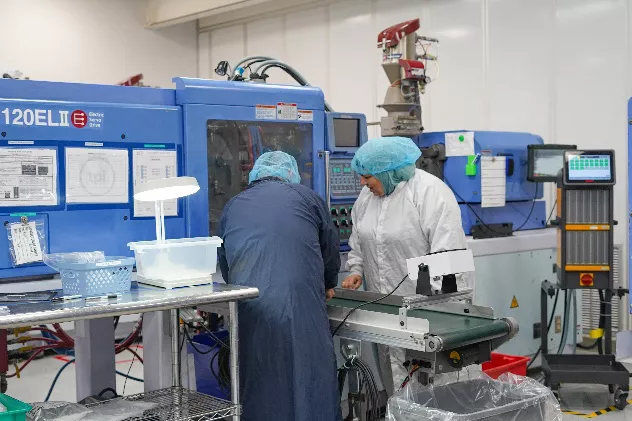
When producing life-critical medical components, consistency and contamination control are non-negotiable. A single speck of dust can completely block a microfluidic channel or ruin a micro-optics component.
To guarantee absolute purity, micro-molded medical components must be produced in highly controlled, particulate-free environments.
At Trademark Plastics, Inc. (TPI), our 100,000-square-foot manufacturing footprint features two certified ISO Class 8 cleanrooms alongside dedicated controlled white rooms. This state-of-the-art infrastructure ensures that every step of the process—from material feeding and micro-injection molding to automated inspection and cleanroom packaging—occurs under strict, particle-controlled conditions, completely eliminating contamination risks.
We follow a rigorous, medical-grade verification protocol to prove that our manufacturing processes are robust, stable, and highly repeatable over millions of cycles.
Our complete validation dossier provides medical OEMs with the ironclad documentation required for seamless FDA compliance and ISO 13485 audits.
Successfully bringing a micro-sized medical device to market requires more than just finding a contract manufacturer with a small injection press. It requires a technical partnership built on scientific molding principles, advanced non-contact metrology, and cleanroom-certified operational excellence.
By partnering with an experienced, quality-first manufacturer, you mitigate your regulatory risks, optimize your design for scalable mass production, and ensure your device performs flawlessly when it matters most.
Ready to de-risk your next high-precision medical device project?Review Our Capabilities: Learn more about our medical manufacturing legacy and explore our cleanroom facilities on the official Trademark Plastics, Inc. (TPI) Company Overview page.